
Understanding your leg veins
Leg veins carry blood back to your heart. When the one-way valves inside them stop working, blood pools and veins begin to show through the skin, as varicose veins, spider veins, reticular veins or telangiectasia.
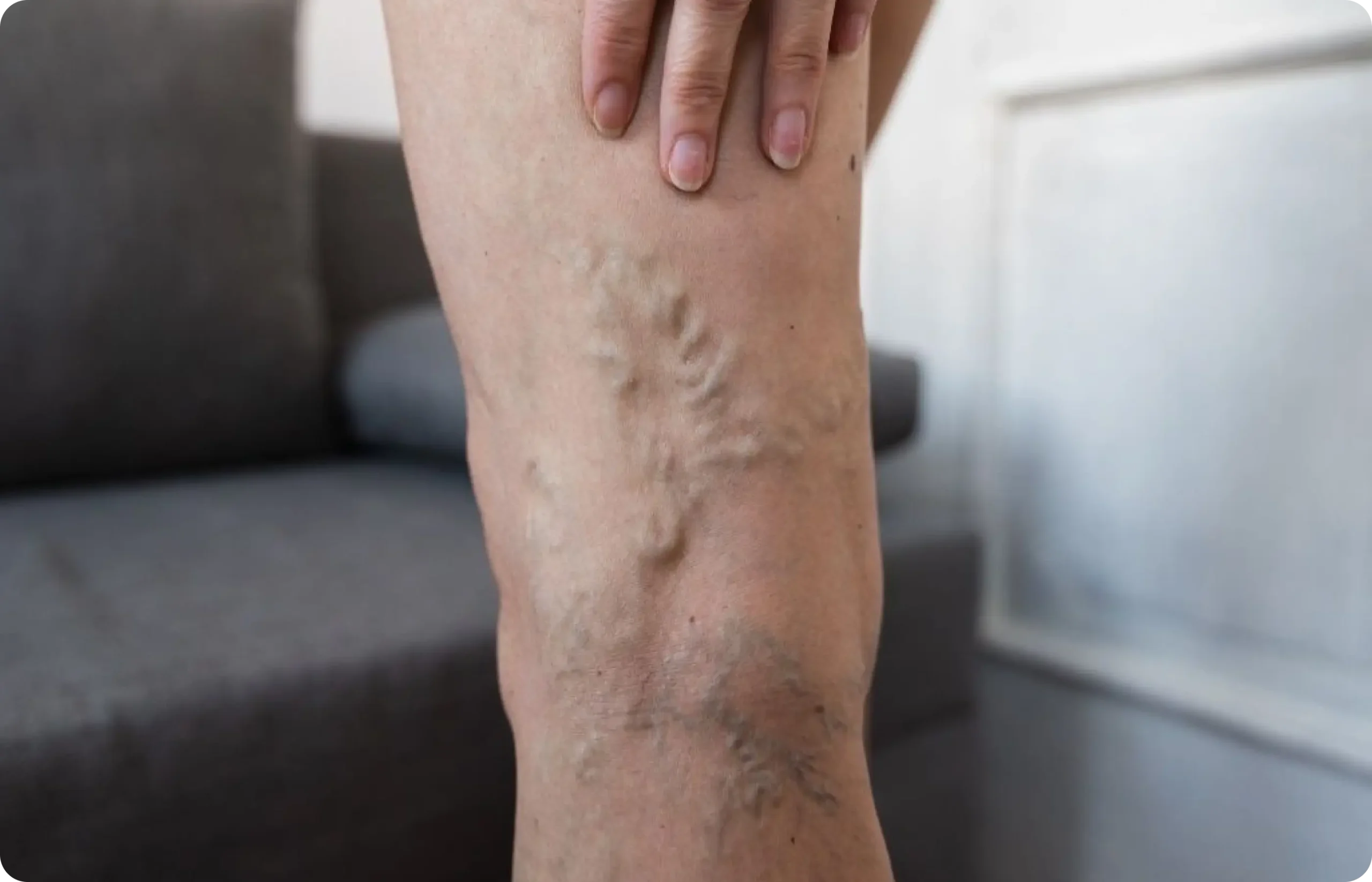
How leg veins work
Your heart pumps blood out through the arteries. The veins drain it back again. In the legs that means moving blood upwards, against gravity, through two separate systems.
Both systems have to work together for the leg to clear properly.
Working valve, normal flow
The valve opens to let blood travel up towards the heart, then shuts to stop it flowing back down. The vein wall stays a normal calibre.
Types of leg veins
Leg veins range from the finest red threads to large bulging blue vessels. Size and position usually determine which treatment is appropriate.
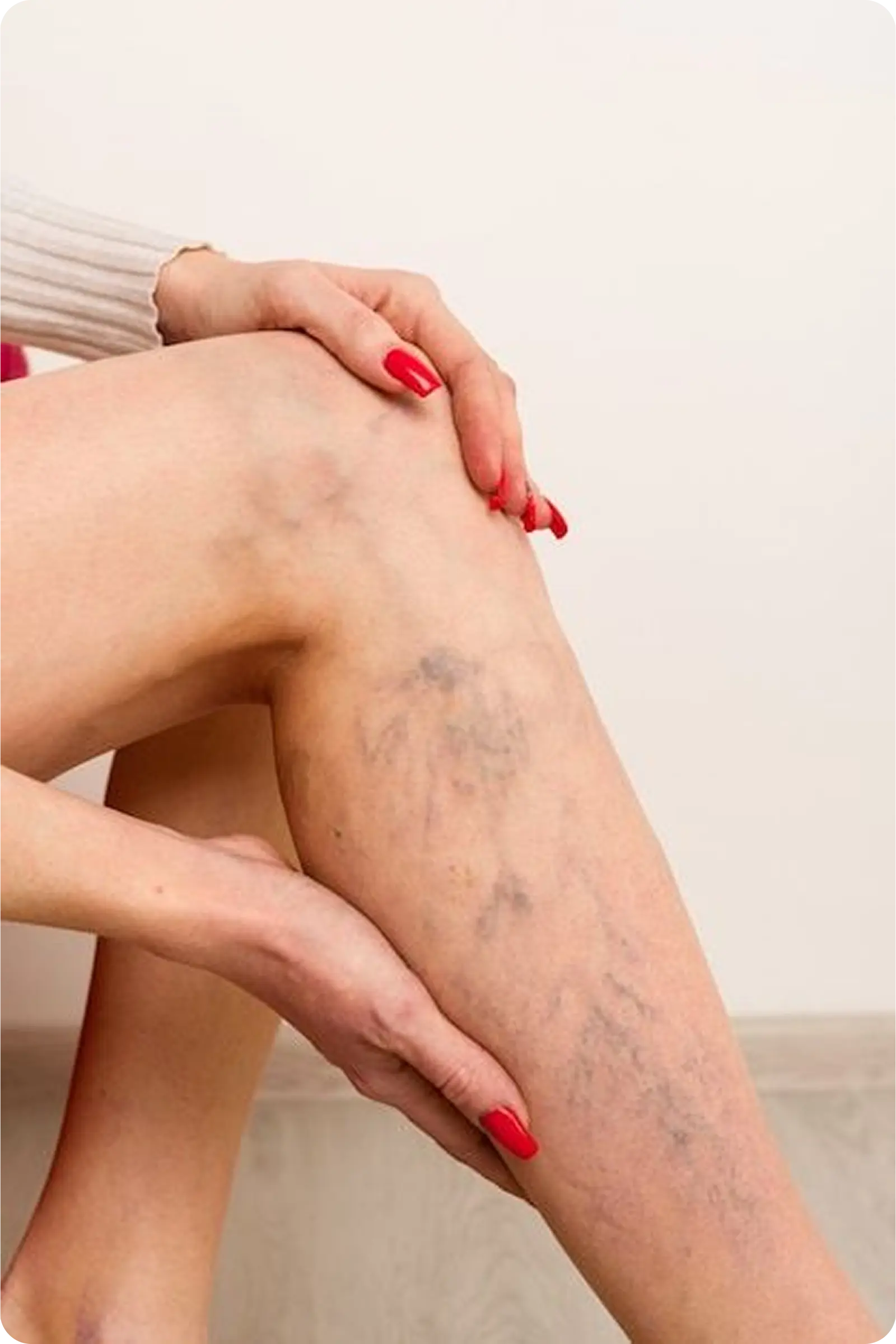
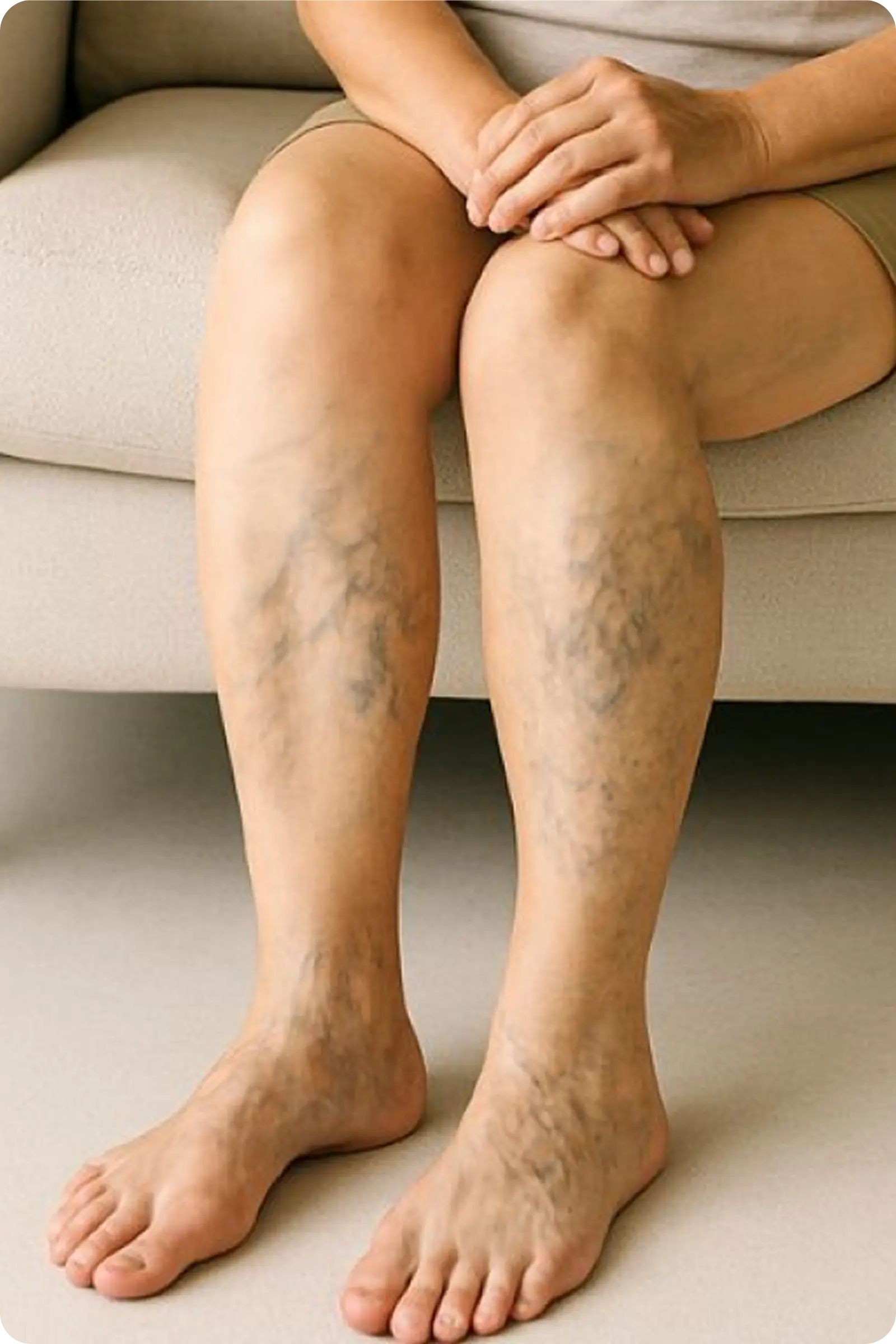
Reticular veins
Superficial varicose veins that feed directly into areas of spider veins.
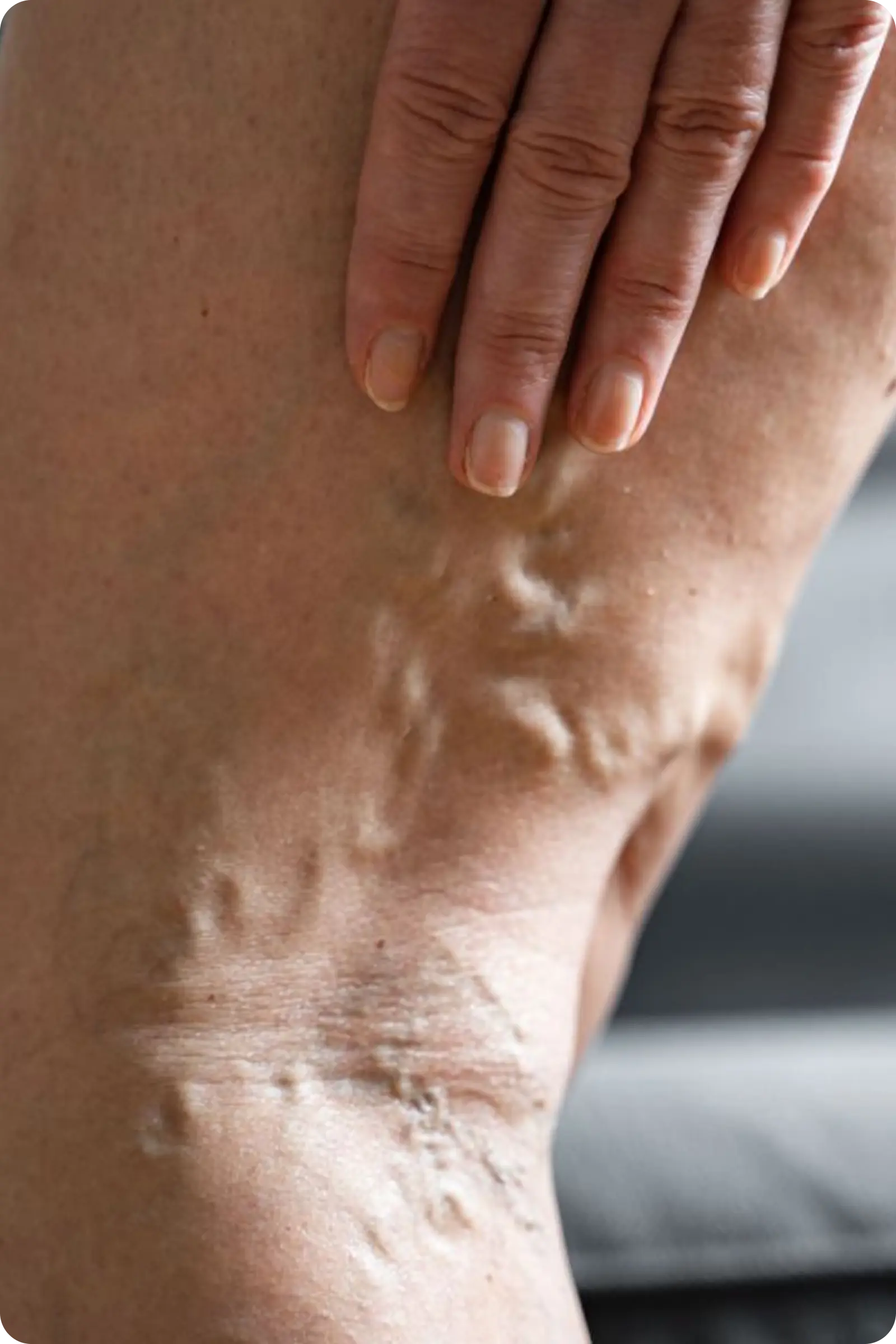
Varicose veins
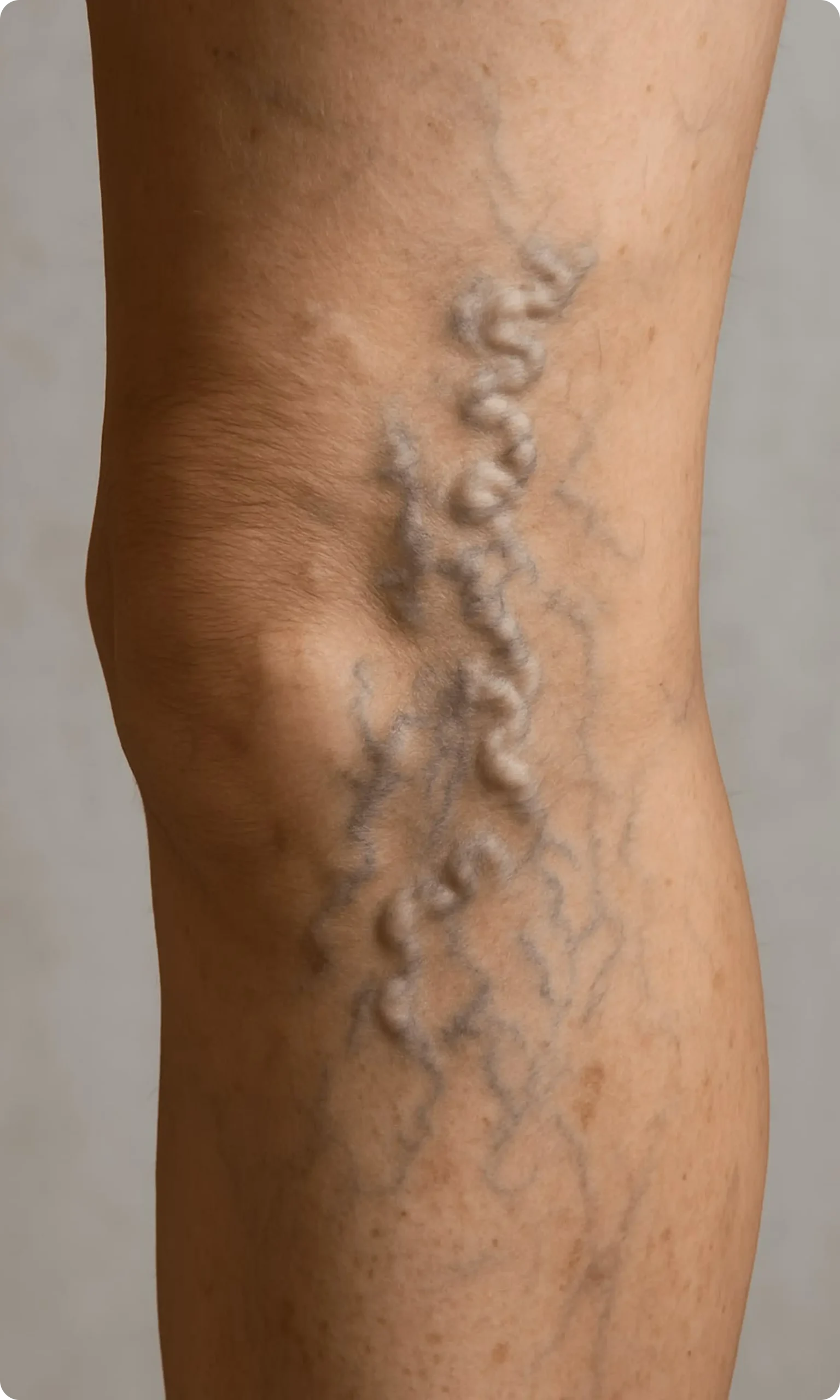
Much larger blue veins, graded 1 to 4 by size and how far they bulge above the skin.
Why veins bulge
Once a valve stretches and stops closing, blood falls back down the leg. Pressure builds in the surface veins, the wall thins, and the vein starts to bulge. Veins that bulge above the skin almost always arise from one of two drainage systems.
Runs up the inside of the leg.
Sits behind the knee.
Chronic Venous Insufficiency
Sustained backward pressure from the deep veins into the surface veins compromises blood flow into the leg. Over time it causes swelling and progressive skin damage.
What causes leg veins
Family history is by far the strongest factor. If you inherit the tendency, everything below will aggravate it. If you don't, those same factors won't necessarily cause veins to develop at all.
Family history
The tendency can come from either parent, and risk is considerably higher when both parents have leg veins. It sometimes appears to skip a generation: where parents are unaffected, there is often a strong history in grandparents.
Pregnancy
Weight gain, increased blood volume, pressure from the uterus and stretch-related hormones all stress the vein system, especially in the third trimester. Each successive pregnancy tends to worsen veins more and recover less.
Sex & hormones
Far more common in women. When men present, it is much more likely to be varicose veins than spider veins. Many women link spider veins to the oral contraceptive pill, though no causal receptor link has been proven.
Prolonged standing
Occupations spent standing still carry increased risk: hairdressers, theatre nurses, surgeons and production line work among them.
Weight
Obesity is associated with leg veins, but it is not direct cause and effect. Thin people can have extensive veins, and people who are overweight can have none at all.
Can leg veins be prevented?
Not entirely. There is no proven way to stop varicose and spider veins from ever developing, but there are things that reliably slow how fast and how severely they progress.
May slow progression
Worth knowing
No supplement has been scientifically proven to maintain “vein wall health” or prevent veins, despite marketing claims. Horse Chestnut may ease some symptoms.
There is no evidence linking smoking to leg vein severity, though it is firmly linked to arterial damage, heart attack and stroke.
One special case:
after a DVT
A deep vein thrombosis blocks a deep vein, usually in the calf, pushing blood into the surface veins and causing secondary varicose veins. Support stockings after a DVT may help prevent these, and more importantly reduce the chance of longer-term circulation problems known as Post Thrombotic Syndrome.
Treatment options
There are four ways to close a leg vein. Which one suits you depends on the size of the vein, its position on the leg, and whether there are underlying deep vein problems.
Surgery
Now widely regarded as the treatment of last choice, reserved for the most severe cases such as veins with skin ulcers. Effective non-surgical options and high recurrence rates after surgery have largely replaced it.
Sclerotherapy
Injection-based treatment. Used on spider or varicose veins at the skin surface, or guided by ultrasound to accurately reach deeper varicose veins.
Heat
Heat seals and destroys the vein, generated by either a laser or a radiofrequency machine. Able to treat both surface and deeper veins.
Glue
A medical adhesive is delivered inside the vein to seal it shut. The newest of the endovenous treatments, and the only one that uses no heat, so no anaesthetic injections along the leg are needed.
Our six treatments
We do not perform vein surgery. The six treatments below cover sclerotherapy, heat and glue, applied either at the skin surface or inside the vein under ultrasound guidance.
Endovenous means “inside the vein”. These treatments use a fine catheter or fibre passed inside the vein through a tiny entry point, with ultrasound guiding the doctor. Endovenous laser ablation, radiofrequency ablation and medical glue are all endovenous treatments.
Leg vein questions and terminology
Plain answers to the terms you will come across, and the questions patients ask most often before booking.
What is the difference between telangiectasia, venulectasia and a venular flare?
These are the medical names for different kinds of spider vein. The smallest spider veins are red in colour and medically we term these tiny blood vessels telangiectasia. Slightly larger spider veins are blue to purple in colour and medically we term these venulectasia. Spider veins can be isolated or can form a cluster, in which case it is known as a venular flare.
What do Grade 1 to Grade 4 varicose veins mean?
Varicose veins are much larger blue veins that are graded from Grade 1 to Grade 4 depending on how large they are and whether they bulge above the surface level of the skin, with Grade 4 being the largest.
What are reticular veins and why are they treated first?
The superficial varicose veins that feed into areas of spider veins are called Reticular Varicose Veins. To treat spider veins, these feeder veins usually also need to be treated for the best results.
What is Chronic Venous Insufficiency (CVI)?
When the backward pressure from the deep veins to the surface veins increases, this back pressure, called Venous Reflux, can compromise the flow of blood from the arteries into the legs. When this back pressure becomes excessive it can result in swelling and damage to the skin, called Chronic Venous Insufficiency (CVI).
The skin changes from CVI in the lower leg can range from dryness through to brown staining, eczema (varicose eczema) and, in severe cases, ulcer formation (varicose ulcer).
What is the difference between EVLT, EVLA and ELT?
They all describe the same procedure. When using a laser to treat deeper veins it can generally be called Ultrasound Guided Laser, however the procedure is commonly referred to as EVLT (EndoVenous Laser Treatment), a term originally registered by the manufacturer of the first laser kit used for it.
There are now many different makes and models of lasers and laser fibres used to perform this procedure, so terms like EndoVenous Laser Ablation (EVLA) and Endovenous Laser Therapy (ELT) have become more frequently used as general terms. See our EVLA page for how it is performed.
What are VENEFIT and Closure Fast?
Radiofrequency ablation uses a radiofrequency machine to generate the heat needed to treat deeper varicose veins through a catheter. The procedure is commonly referred to as VENEFIT, which is the name given to it by the manufacturer, and the catheter used is called Closure Fast, a marketing name highlighting the speed of the procedure.
What does endovenous mean?
The term endovenous means "inside the vein". To deliver energy below the surface of the skin requires a small tube, called a catheter, to be inserted through a tiny skin incision, with ultrasound used to visualise and guide the treatment of these deeper veins. Ultrasound guided treatments are often referred to as endovenous to distinguish them from surface vein treatments.
What is a phlebologist?
A leg vein consultation is conducted by one of our experienced medical practitioners who specialise in the assessment and management of leg vein disorders, called a phlebologist.
Do nutritional supplements prevent varicose veins?
Whilst there are supplements such as Horse Chestnut that can sometimes help alleviate some of the symptoms from leg veins, there are no supplements that have been scientifically proven to maintain "vein wall health" and prevent varicose veins and spider veins, despite marketing claims.
Why are support stockings recommended after a DVT?
Following a deep vein thrombosis (DVT), which is essentially a blockage to a deep vein usually in the calf, blood can be pushed into the surface veins causing what are called secondary varicose veins.
The use of support stockings after a DVT may help prevent these types of varicose veins, but more importantly will help minimise the chance of developing chronic circulation problems, called Post Thrombotic Syndrome.
Can leg veins be cured permanently?
It always needs to be borne in mind that whether you treat leg veins or not, if you have a tendency to get varicose veins or spider veins in the first instance, then you will still have a tendency to develop more in the future. In treating varicose veins and spider veins we are trying to control the problem rather than being able to cure them permanently.
Do I need a GP referral?
Whilst many patients are referred to our clinic by their GP, a referral is not necessary to be able to claim back a Medicare rebate for a leg vein consultation. A referral from your GP or from one of our leg vein doctors is required for a Medicare rebate on a mapping scan. Full costs are set out on our fees page.
Leg vein assessment
Your consultation is conducted by one of our experienced phlebologists, doctors who specialise in assessing and managing leg vein disorders.
A GP referral is not required to claim the Medicare rebate on your consultation.
History
Your vein symptoms, past treatments, family history, other conditions, medications and allergies.
Examination
From groin to feet, so bringing a pair of shorts to your appointment is helpful.
Doppler ultrasound
Screens the groin and back of the knee for deep vein problems. Gel on the skin and gentle squeezing; not uncomfortable.
Your plan
Findings explained and options discussed. A more detailed mapping scan may be recommended.
Mapping scan
A far more detailed look at the deeper leg veins using Duplex Ultrasound, whose colour flow imaging pinpoints the site and degree of any underlying problem. You will stand for part of it, and it is not painful.
Same doctor, start to finish
We are a Government accredited Medical Imaging Service. Your scan is performed in our rooms by the same doctor who performs our ultrasound guided treatments, so results are discussed on the spot with no extra review appointment.
A referral from your GP or one of our leg vein doctors is required for a Medicare rebate on the mapping scan.
Find out exactly what is happening in your legs
A consultation gives you an ultrasound assessment, a clear explanation and a management plan. No GP referral needed.
Not sure what is going on with your legs? Just ask.
Tell us what you can see on your legs and what is bothering you. A member of our Melbourne team will reply within one business day, or point you to the right consultation. Your enquiry is confidential.
Send a question
No referral needed. No obligation to book.